Checking palm scan in Entry Monitoring
|
|
This sub-section is only applicable at PVTC Selects and PVTCs with a proctor workstation that is equipped with an admissions tablet. Pearson contacts test centers if they must have a proctor workstation and/or this equipment installed. |

If the exam sponsor requires you to verify a candidate's palm scan, the Palm Scan: Entry Monitor – Sign In/Sign Out window appears after you click Check Palm Scan in Entry Monitoring.
Follow these steps to verify the candidate's palm scan during entry or exit monitoring:
- When the Palm Scan: Entry Monitor – Sign In/Sign Out window appears, pick up the admissions tablet at the proctor workstation.
- If needed, open the Admissions Manager application on the admissions tablet.
- Log in to Admissions Manager on the admissions tablet. Use the same username and password that you use for the other VUE applications.
|
|
In addition to your username and password, Admissions Manager may also ask you to enter your test center's site ID after software updates occur. Note that the admissions tablet may take up to 30 seconds to connect to the VUE Testing System (VTS) when logging in with the site ID. |
|
|
If the admissions tablet is inactive for more than 15 minutes, you will be logged out of Admissions Manager. You will need to log in again before you can verify more palm scans. |
After logging in, you should see the Candidate finder screen.
-
Find the candidate record for the candidate whose palm scan you are verifying. You have two options to do this:
-
Option 1: Scan the QR code.
-
On the admissions tablet, select Scan QR code. This turns on the admissions tablet's camera.
-
Locate the QR code, which is displayed in the Palm Scan: Entry Monitor – Sign In/Sign Out window on the proctor workstation computer.
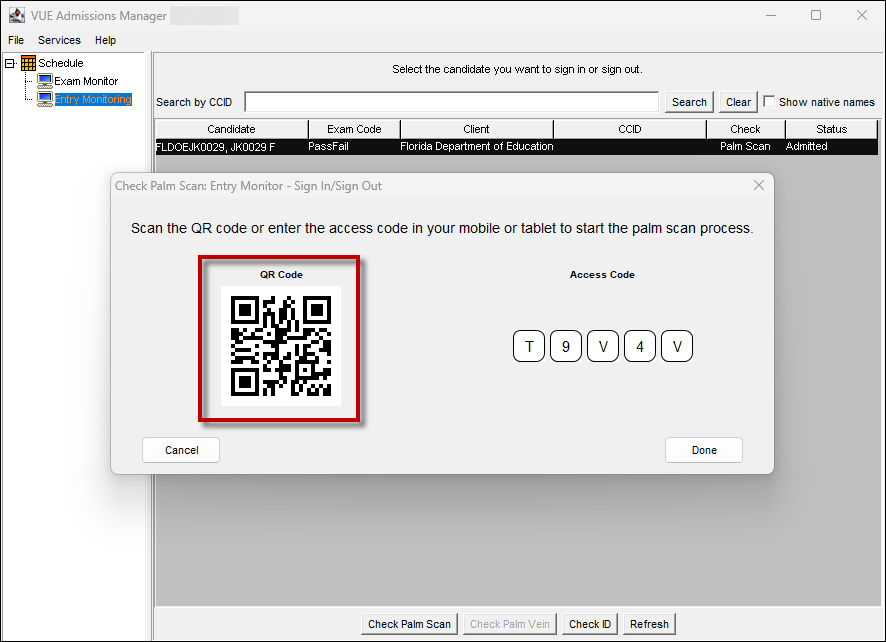
- Point the admissions tablet's camera at the QR code to scan it.
-
Option 2: Enter the access code.
- Locate the access code, which is displayed in the Palm Scan: Entry Monitor – Sign In/Sign Out window on the proctor workstation computer.
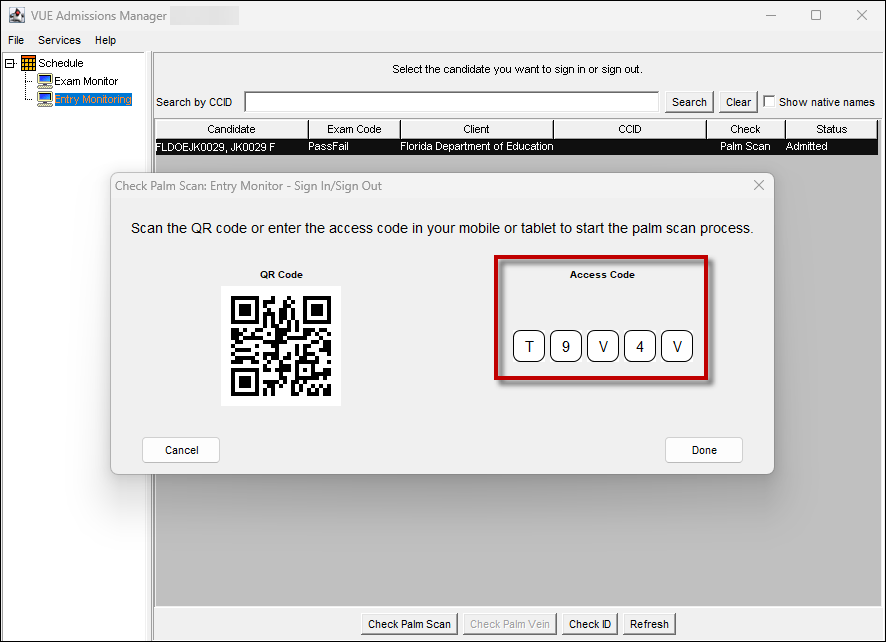
- Type the access code into the Enter access code field on the admissions tablet.
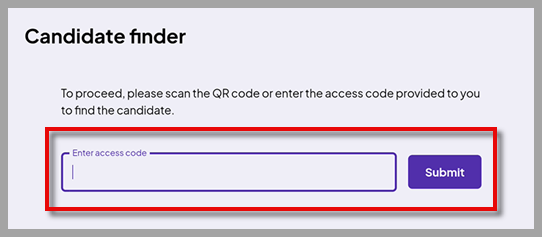
- Select Submit.
When the admissions tablet finds the candidate record, the Candidate information screen appears. The Palm capture status shows as "Not captured."
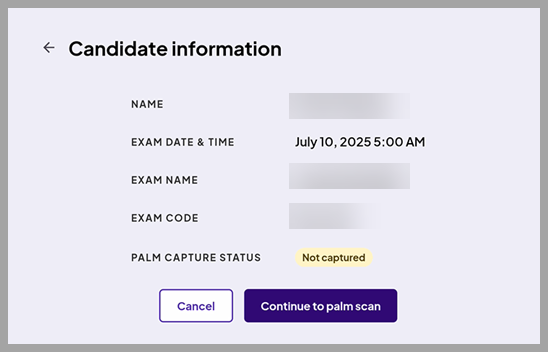
- Confirm that the candidate's name and exam are correct on the screen.
If the candidate's name and exam are not correct, select Cancel on the admissions tablet. Do not scan the candidate’s palms. Return to Entry Monitoring on the proctor workstation. Verify that the correct candidate is selected and that the candidate was admitted correctly. If the candidate was admitted incorrectly or there is a different problem, contact VSS.
- If the candidate's name and exam are correct, select Continue to palm scan.
-
Follow the same steps you use to enroll a first-time candidate (see Steps to capture palm scan for enrollment). Unlike the initial enrollment process, however, candidates only need to scan their open palm and complete a randomized gesture once per hand.
The software verifies whether the candidate's palm scan matches the previous palm scan stored in the system for the candidate. However, the admissions tablet will not indicate whether the palm scan is a match—it will only confirm whether the palm scan was captured successfully. Unless there is a technical issue with the admissions tablet, the same notification always appears on the admissions tablet's screen when the palm scan is captured for verification: "Palm scan successfully captured for [candidate name]."
Instead, the Entry Monitoring pane on the proctor workstation will indicate whether the palm scan is a match. There are three possible outcomes from the verification. See the following table for instructions on how to proceed for each outcome:
|
Outcome |
Instructions |
|
The palm scan is a match. |
If the only window you see on the proctor workstation is the Palm Scan: Entry Monitor – Sign In/Sign Out window, then the palm scan is a match. Continue to step 8. |
|
The palm scan is not a match. |
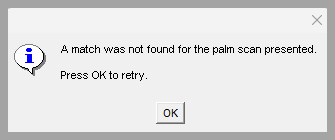
If the palm scan is not a match, the following message on the proctor workstation informs you that a match was not found:
Select OK and then go back to step 1 of this process to retry the palm scan process. |
|
The palm scan is still not a match after retrying. |
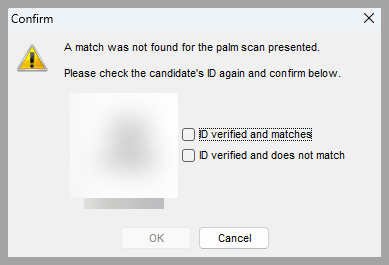
If the palm scan is still not a match after retrying the palm scan process, the following message on the proctor workstation informs you that a match was not found:
Recheck the candidate's primary ID, and compare it to the photo on the screen. (If there is no photo on the screen, compare the photo on the ID to the candidate in front of you.)
|
|
|
If a technical issue prevents you from verifying the candidate's palm scan, see Troubleshooting palm scan issues. |
- Set the admissions tablet on the desk and return to the Entry Monitoring pane on the proctor workstation computer.
- Click Done on the Palm Scan: Entry Monitor – Sign In/Sign Out window.
The following screen appears:
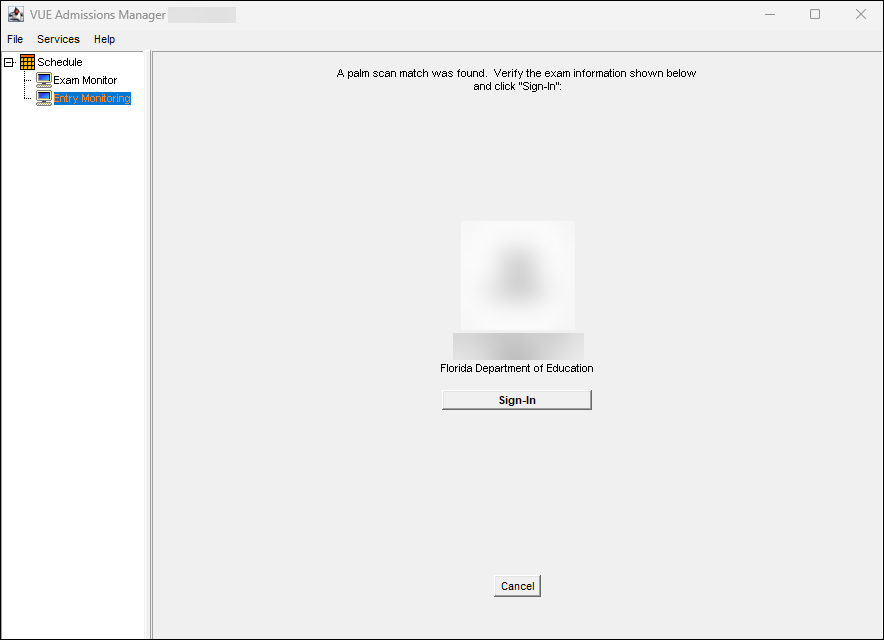
- Verify the candidate's name and confirm that the exam listed is the one the candidate is currently taking.
- Select Sign-In or Sign-Out if the candidate's information is correct, or click Cancel if the information is incorrect.
If you click Cancel, a message warns you that the candidate has not been signed in or out. After you close the message, the candidate list appears. Verify that the correct candidate is selected and that the candidate was admitted correctly. If the candidate was admitted incorrectly or there is a different problem, contact VSS.
Copyright © 2026 Pearson, Inc. or its affiliates. All rights reserved. Pearson Confidential.